The Highlands are usually sold as a road trip: a hire car, a full tank, a long sweep up the A9. But the north has another network, and it is one of the best in Britain. Trains run through glens you would never see from a lay-by, coaches meet the ferries, and the whole loop from Inverness to Skye and back down the west coast works perfectly well with a rucksack and a little patience. What follows is a route I would happily repeat: slow, cheapish, and almost entirely car-free.
The route in outline
Nothing here is fixed, but this order makes the transport connections line up with the least hanging about. Give it a week, or two if you want to walk properly.
- Inverness — a night or two, plus a day trip on the Kyle Line.
- Inverness to Kyle of Lochalsh by train, breaking the journey at Plockton.
- Kyle to Skye by coach over the bridge, or continue by rail to Mallaig and take the CalMac ferry to Armadale.
- Armadale to Portree by local bus, along the Sleat peninsula and up through Broadford.
- Portree as a base for Trotternish, the west coast and the Cuillin.
- Skye to Mallaig by ferry, then the West Highland Line to Fort William and onward.
Inverness, and the Kyle Line west
Inverness is the right place to start because everything radiates from it. The station serves the Kyle Line, the Far North Line to Thurso and Wick, and the Aberdeen and Perth routes; the bus station next door handles the Citylink coaches. It is also a decent town to spend a wet afternoon in, with a good second-hand bookshop, a museum worth an hour and a couple of pubs that do better food than they let on. Local buses reach Culloden and the Black Isle if you want to stretch your legs before the real travelling begins.
The Kyle Line is the reason to come. It leaves Inverness and follows the Beauly Firth, then climbs away from the coast into moorland, passing lochs that appear without warning and vanish again behind a shoulder of hill. There is no trolley, so buy something at the station first. Sit on the loch side if you can and ask the conductor which that is — the best views change with the direction of travel, and regulars will tell you happily.
Break the journey at Plockton. It is a request stop, so tell the conductor before you arrive, and step off into a village of palm trees, a sheltered harbour and a pub that has been feeding travellers for a very long time.
Kyle of Lochalsh itself is small and practical: a Co-op, a couple of cafés, a view across to the bridge. You do not need long there.
Crossing to Skye
Two ways over, and both are good.
Over the bridge
Stagecoach and Citylink coaches run from Kyle of Lochalsh across the Skye Bridge to Broadford and on to Portree. It is quick and unglamorous, and it drops you in the middle of Portree with your bags. If you are coming straight from Inverness, the Citylink coach to Portree is the simplest single journey of the whole trip — roughly three and a half hours, with the scenery doing most of the work.
By ferry from Mallaig
The CalMac crossing from Mallaig to Armadale takes about half an hour and is the more romantic option, particularly if you have come down on the train past Glenfinnan. Foot passengers rarely have trouble getting on, but vehicles should be booked well ahead in summer. From Armadale, a local bus runs north through the Sleat peninsula to Broadford, where it connects with services to Portree.
Skye without a car
Skye rewards a slow approach. The island's bus network fans out from Portree: north to Uig and around the Trotternish coast, west towards Dunvegan, and south to Broadford and the Armadale ferry. Services are not frequent, and they thin out badly on Sundays, so build your days around two or three fixed departures rather than trying to squeeze everything in.
Portree is the obvious base. It has a hostel, a Co-op, a bakery, a harbour and enough places to eat that you will not be bored after four nights. Book accommodation early between May and September; the island fills up, and turning up hopeful in July is a miserable business.
- Trotternish — buses along the east coast pass the Old Man of Storr car park and the Quiraing. Get off, walk up, walk back down, and catch a later bus.
- Cuillin and Glenbrittle — reachable by a combination of buses and a long walk; check times before committing.
- Sligachan — a junction with a famous old hotel and a fine view of the ridge, and on the main Broadford to Portree route.
- Dunvegan — castle, lochs and a westward bus that feels like a day out in itself.
Take midges seriously from June to August, especially near water in still, damp weather. A midge hood is not a fashion statement; it is equipment.
Down the west coast: Mallaig and the West Highland Line
From Armadale, the ferry lands you in Mallaig, a working harbour town with a chandlery, a fish and chip shop and a hostel up the hill. It is a good place to stop for the night rather than rush onwards.
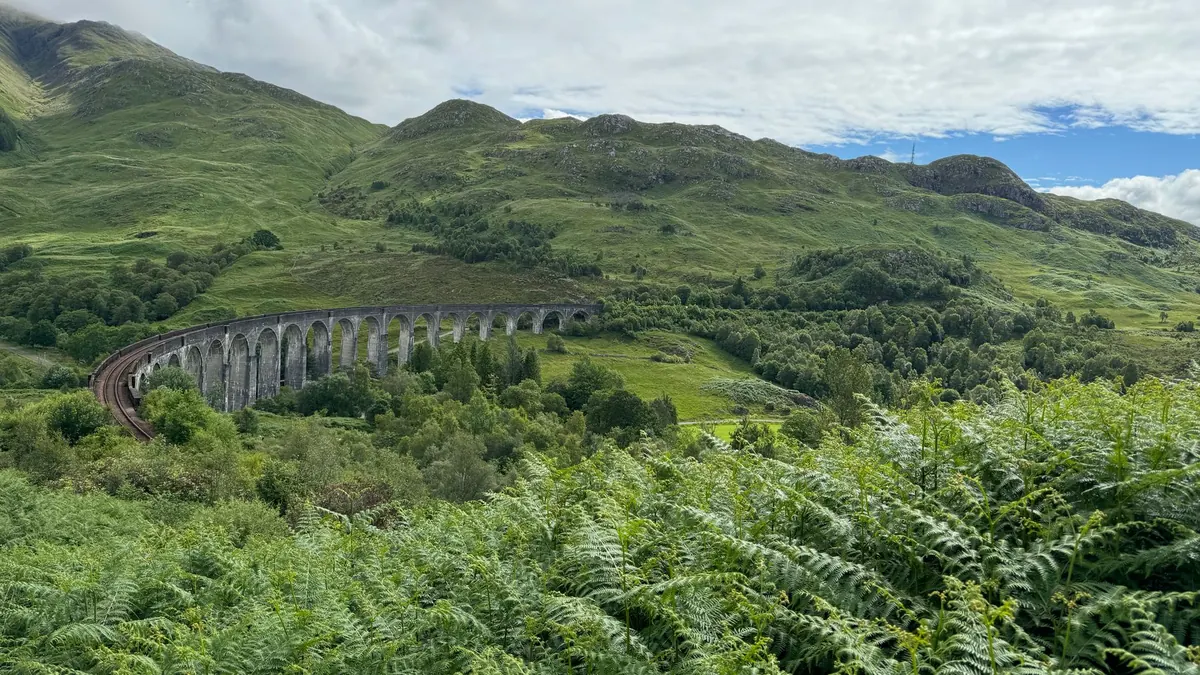
The train from Mallaig to Fort William runs on the West Highland Line and crosses the Glenfinnan Viaduct about halfway. In season, a steam service runs the same route; it is expensive and popular, and you need to book a long way ahead, but the ordinary ScotRail trains give you the same scenery for the price of a normal ticket. From Fort William, trains continue south towards Glasgow, and there are buses onwards to Oban and the coast.
If you would rather skip Mallaig, Citylink coaches run from Portree to Fort William and on to Glasgow, crossing back over the bridge and through Glen Shiel. It is a long day on a bus, but a spectacular one.
Where to sleep
Hostels make this route work. Hostelling Scotland has properties in Inverness, Portree, Broadford and Glenbrittle, among others, and there are independent hostels and bunkhouses scattered along the same route from Mallaig to Kyle. Bothies offer free, very basic shelter in remoter spots — no water, no toilet, no booking, and a strict leave-no-trace rule.
Two habits are worth adopting. Book your first two nights before you travel, so you are not solving accommodation while tired and hungry. And keep one flexible night in the middle of the trip, because weather and ferries do not consult your itinerary.
Practical notes before you go
- Check timetables close to your dates. Services change seasonally. Traveline Scotland, ScotRail, Citylink and CalMac are the four worth bookmarking.
- Expect fewer Sunday services in the more remote corners, and plan a rest day rather than a panic.
- Ask about through tickets and passes. A single ticket covering rail, ferry and coach can be cheaper than buying separately, but the maths varies — compare it against point-to-point fares.
- Reserve a bike space if you are carrying one. Rail and ferry spaces are limited and cannot be sorted at the platform.
- Pack for four seasons in one day. Waterproof jacket and trousers, warm mid-layer, hat and gloves. Trainers are fine for low-level paths; boots if you are going up.
- Carry food. Village shops close early, Sunday opening is limited on Skye, and the gap between lunch and dinner can be longer than you expect.
- Keep some slack. High winds occasionally stop ferries, and a missed connection is much less stressful when the next day is free.
Do it slowly. The point of travelling this way is not to tick off Skye in three days, but to spend the journeys looking out of the window — and the Highlands, as it happens, are very good at that.
Photo: Geert Rozendom / Pexels